Transforming glioblastoma research by establishing a pioneering Zebrafish Avatar model that can simulate a patients’ glioblastoma response to therapy, providing a scalable and cost-effective alternative to traditional models and driving innovative research methodologies.
The zBRAIN project is a clinical study leveraging zebrafish patient-derived xenografts of glioblastoma (Zebrafish Avatars) in order to predict the patient clinical outcomes and their response to standard and novel treatment through a combined biomarker analysis. This innovative approach integrates animal modelling into clinical setting for the prediction of tumor behavior, marking a significant advancement in translational personalized medicine in neuro-oncology. The two General Objectives of zBRAIN are: A} To transform glioblastoma research
by establishing a pioneering Zebrafish Avatar model that can simulate a patients’ glioblastoma response to therapy, providing a scalable and cost-effective alternative to traditional models and driving innovative research methodologies. B} Advance Personalized Medicine: Develop and validate predictive models using patient-specific biomarkers to enhance treatment precision, offering tailored therapeutic strategies and setting new standards in personalized cancer care.
zBRAIN (Figure 1)addresses the critical need for more effective treatment outcome prediction and new treatments by introducing zebrafish avatars as a novel translational research tool. This project stands out for its unique approach to integrating personalized medicine with high-throughput drug screening, providing actionable insights into tumor behavior and therapeutic responses. By pioneering the use of zebrafish avatars in a clinical setting, zBRAIN aims to significantly improve patient-specific treatment strategies, enhance the understanding of glioblastoma, and reduce the time and cost associated with drug development.
Glioblastoma is one of the most aggressive and difficult-to-treat cancers. Traditional models often fail to capture the complexity and heterogeneity of human tumors, leading to limited success in translating preclinical findings to clinical practice. zBRAIN’s innovative approach promises to bridge this gap by providing a more accurate and scalable model for studying glioblastoma, ultimately leading to better patient outcomes and advancing the field of cancer pharmacology. 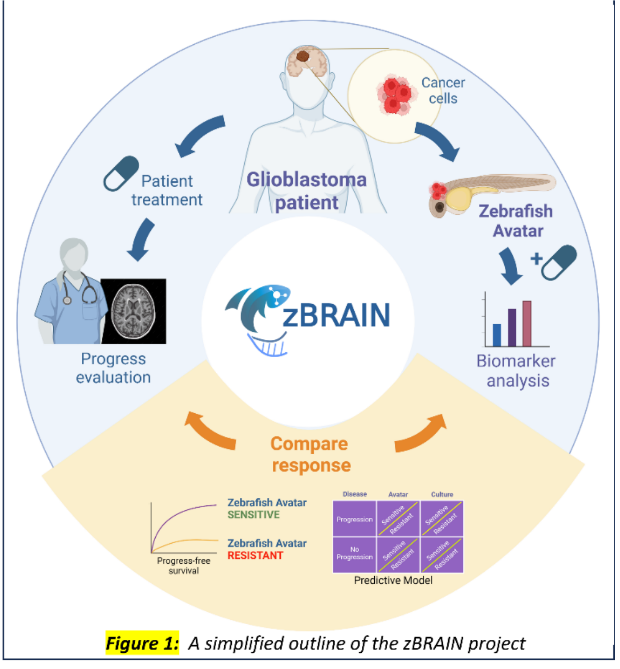 The zBRAIN project aligns with the Programme and Call objectives. The zBRAIN proposal, funded in the frame of the Operational Programme «ΘΑλΕΙΑ» 2021-2027 under Priority 1, fully satisfies and complies with the «Competitive, Smart and Digital Economy» and the Specific Objective (1i): «Developing and enhancing research and innovation capacities and the uptake of advanced technologies». Per the description cited in this Call for Proposals, according to the “Framework for State aid for research and development and innovation (2014/C 198/01)” and article 2 (91) of the General Block Exemption Regulation”. Our activities span Technology Readiness Levels (TRLs) 1-4, focusing on basic principles, concept formulation, proof of concept, and laboratory validation. Detailed information on TRLs is described in Section B1.3. The project directly addresses the S3CY Priority Sector 7.1.3: "Personalised medicine using genetic or other biomarker information to provide personalised treatment to patients."Glioblastoma treatment faces significant challenges in the clinic. Existing models often fail to accurately predict individual patient responses to therapies, leading to ineffective treatments and poor clinical outcomes. Also, the heterogeneity of glioblastoma, complicates treatment and different patients respond differently to the same therapy. Lastly, current treatments do not fully account for patient-specific factors, resulting in generalized and often suboptimal therapeutic strategies. zBRAIN aims to address these challenges by developing Zebrafish Avatars to create predictive models integrating multiple patient-specific biomarkers. This approach will enhance the precision of treatment strategies, addressing tumor heterogeneity and advancing personalized medicine in glioblastoma care. By integrating Zebrafish Avatars into co-clinical studies, zBRAIN will provide critical insights and real-time feedback on effective drug combinations, ultimately enhancing patient-specific therapeutic strategies and advancing the field of cancer pharmacology. This project has the potential to create a paradigm shift in how we study and treat glioblastoma, offering hope for improved patient outcomes and fostering future research collaborations and funding opportunities.